Barbershop Consultation: What Should You Tell Your Barber?

You sit down, the cape snaps around your neck, and your barber asks the question that decides everything: "What are we doing today?" That moment is where great cuts are born and bad ones begin. A real consultation is not small talk while the clippers warm up. It is a short, focused conversation about your hair texture, your face shape, your lifestyle, and the exact words that describe the style sitting in your head. This guide breaks down what to actually say in that chair, the terminology that separates a vague request from a precise one, and the questions worth asking before a single hair hits the floor. By the end, you will walk into any shop ready to have a conversation that gets you the same result every time.
Key Takeaways
A good consultation covers four things every time: your face shape, your hair's natural texture, your daily routine, and a clear reference point for the style.
Learning basic barber vocabulary (taper, fade, guard numbers, texturizing) turns a guessing game into a precise order.
Bringing one clear reference photo beats describing a celebrity's entire look, because lighting, hair density, and face structure vary person to person.
Speaking up mid-cut, politely and early, prevents small issues from becoming a style you have to live with for six weeks.
The best client-barber relationships are built on repeat visits and consistent communication, not a lucky first appointment.
Why the Consultation Is the Most Important Five Minutes in the Chair
A barber can only build what you describe to them. Hand them vague instructions like "just clean it up" and you are handing them a blank check written in a language neither of you fully understands. The consultation exists to close that gap before the clippers ever touch your head. It is a negotiation between what you imagine, what your hair can physically do, and what your barber's trained eye sees when they look at your head shape, growth pattern, and cowlicks.
Think of it the way a contractor thinks about blueprints. Nobody hands a builder a stack of lumber and says "make it look nice." They walk through rooms, point at finishes, discuss budget and timeline. A haircut consultation works the same way, just compressed into a few minutes. The barber is gathering information: How short is too short? Do you style it yourself at home, or do you want something that falls into place without effort? Do you have a cowlick at the crown that will fight a certain part? Skipping this step is like skipping the blueprint phase and hoping the house still ends up with the right number of bedrooms.
What Happens When Consultations Get Skipped
Walk into any shop on a Saturday afternoon and you'll see the fallout of rushed consultations. A guy sits down, mumbles "shorter on the sides," and twenty minutes later he's staring at a reflection that looks nothing like what he pictured. It's rarely the barber's fault entirely. "Shorter" could mean a quarter inch or could mean skin. Without a number, a guard size, or a photo, the barber is forced to guess, and guessing under time pressure rarely produces precision.
This is the single biggest reason repeat clients report higher satisfaction than first-timers. According to data regularly cited in the professional beauty and barbering trade press, client retention in barbershops correlates strongly with the quality of the initial consultation, not just the technical skill of the barber. A skilled barber with no information to work from is still flying blind. A moderately skilled barber with clear direction can hit the mark almost every time.
The Psychological Side of a Good Consultation
There's a comfort factor too. Sitting in a barber chair is oddly vulnerable. You're trusting a stranger with scissors near your ears and a tool that can permanently alter how you look for the next month. A thorough consultation lowers that anxiety because it turns a one-way instruction into a two-way conversation. You get to ask questions. Your barber gets to explain tradeoffs. By the time the cape goes on, you both know the plan.
Veteran barbers will tell you the chair is part therapy session, part technical briefing. Clients open up about job interviews, weddings, breakups, new fatherhood, all while their barber quietly adjusts the plan based on context clues. A guy prepping for a job interview in finance probably doesn't want the aggressive design shaved into his temple that a teenager might request before a school dance. Context shapes the cut as much as the words do.
A Framework for Your First Thirty Seconds
Before you even open your mouth, barbers are already reading your hair: density, growth direction, any thinning patches, natural curl pattern. Your job in the first thirty seconds of conversation is to give them three things:
The length you want to keep, described in a way that's measurable (guard number, finger-width, or "leave enough to comb over").
The look you're trying to achieve, ideally with a reference photo or a clear comparison to a known style.
How much maintenance you're willing to do, because a style that needs daily product and blow-drying is a different request than "wash and go."
Give a barber those three data points and you've done 80 percent of the work. The rest is their craft taking over.
This matters more than people realize, because the gap between "what I asked for" and "what I got" is almost always a communication gap, not a skill gap. Which brings us to the next piece of the puzzle: understanding what your barber is actually assessing when they look at you before the first word is even spoken.
Reading the Room: What Your Barber Is Actually Looking At
Before your barber asks a single question, their eyes are already working. Trained barbers assess head shape, hairline pattern, cowlicks, hair density, and even posture within the first few seconds of you sitting down. Understanding what they're looking for helps you anticipate the questions they'll ask and gives you language to describe things you may have never thought to mention.
Hairline and Growth Pattern
Your hairline is not a straight, predictable thing. Most men have some combination of a widow's peak, a receding temple, or an asymmetrical line where one side sits slightly higher than the other. A good barber clocks this immediately because it affects how a fade blends or how a hard part will look. If you have a pronounced widow's peak, for example, certain fringe styles will naturally frame it, while slicked-back styles will emphasize it.
Mention any hairline concerns upfront. If you're self-conscious about a receding temple, say so. Your barber can adjust the cut to minimize the visual impact, often by keeping more length at the front and blending it into a shorter fade at the sides.
Cowlicks and Whorls
A cowlick is a spot where hair grows in a circular pattern instead of a uniform direction, most commonly at the crown. These little whirlwinds have ruined more "simple" haircuts than almost anything else, because a style that looks great in a photo might completely fight your crown's natural direction. If you have a stubborn cowlick, your barber needs to know, or they'll find out the hard way mid-cut when hair refuses to lie flat.
Tell your barber: "I've got a cowlick right here that always sticks up" and point to it. This single sentence can save an entire appointment from going sideways.
Hair Density and Texture
Density refers to how many hairs you have per square inch. Texture refers to the shape of each strand: straight, wavy, curly, or coily. These two factors determine how a style will actually sit on your head, independent of what it looked like on the guy in your reference photo.
Hair Texture | How It Behaves | Styles That Work Well |
Straight | Falls flat, holds less volume without product | Textured crops, slick-backs, low fades |
Wavy | Natural movement, moderate hold needed | Side parts, quiffs, medium fades |
Curly | Shrinkage when dry, needs moisture | Curly fringe, afros, taper with curl definition |
Coily | Significant shrinkage, high versatility | Fades, twists, braids, shape-ups |
Knowing your own texture category before you sit down helps you have a more productive conversation. If you have coily hair and bring in a photo of a guy with straight hair wearing a slicked side part, your barber needs to tell you that the same style will look and behave completely differently on your head. That's not bad news, it's useful information that redirects you toward a style built for your actual hair.
Face Shape Assessment
Barbers also size up your face shape almost instinctively: oval, round, square, rectangular, diamond, or heart-shaped. This isn't vanity talk, it's functional. Certain haircuts add visual length to a round face, while others add width to a narrow one. We'll dig deeper into this in the next section, but it's worth knowing that your barber is already doing this math before you've said a word.
Posture and Daily Habits
Here's a subtle one. Barbers often glance at how you're dressed, whether you're wearing a suit, gym clothes, or a uniform, and sometimes ask directly about your job or routine. This isn't idle chit-chat. Someone who wears a helmet daily for construction work needs a different cut than someone sitting at a desk all day. A tight, low-maintenance fade might suit the former, while the latter might have more flexibility for length on top.
Bringing This Information to the Conversation
You don't need to diagnose your own hair like a professional, but arriving with some self-awareness speeds things up enormously. Before your next appointment, take sixty seconds in front of a mirror and note:
Where your hairline sits and whether it's receding anywhere
Whether you have a cowlick and where
How your hair behaves when it air-dries (this reveals texture)
The general shape of your face when you pull your hair back
Bring these observations into the chair. Your barber will appreciate a client who's done a little homework, and the conversation will move from guesswork to precision much faster.
Understanding what your barber sees is only half the equation. The other half is translating what you want into words your barber actually uses on a daily basis, which brings us to the vocabulary every client should know before their next appointment.
The Words That Matter: Barber Terminology Decoded
Walking into a barbershop without knowing basic terminology is like ordering coffee in a country where you don't speak the language and pointing at the menu. You might get something close to what you wanted, but precision requires vocabulary. Barbers speak in a specific shorthand, guard numbers, fade heights, texturizing terms, and learning even a handful of these words dramatically improves the accuracy of your haircut.
Guard Numbers and What They Actually Mean
Clipper guards are numbered, and each number corresponds to a specific length in inches (though slight variations exist between brands). Knowing these numbers lets you communicate length precisely instead of relying on words like "short" or "medium," which mean different things to different people.
Guard Number | Approximate Length | Common Use |
0 | 1/16 inch (essentially skin) | Skin fades, bald fades |
1 | 1/8 inch | Very short buzz cuts |
2 | 1/4 inch | Classic buzz cut |
3 | 3/8 inch | Short crew cut |
4 | 1/2 inch | Medium crew cut |
5 | 5/8 inch | Longer crew cut, blends |
6 | 3/4 inch | Transition length for fades |
7 | 7/8 inch | Longer top blends |
8 | 1 inch | Rarely used on sides, common on top |
Telling your barber "take the sides down to a 2, blend into a 4 on top" is infinitely more useful than "make the sides shorter please." It removes ambiguity entirely.
Fade Terminology
Fades are described by where the shortest point sits on your head. A low fade starts just above the ear and blends upward gradually, while a high fade starts much higher, near the temple, creating a more dramatic contrast between short and long hair. A mid fade sits between the two. There's also the skin fade (sometimes called a bald fade), which tapers all the way down to the skin at its shortest point, versus a taper, which never goes quite that short and maintains a softer gradient.
Knowing the difference between a fade and a taper alone eliminates one of the most common miscommunications in barbershops. A client who wants a subtle, professional look often actually wants a taper, not a fade, but uses the word "fade" because it's the more commonly known term. Clarifying this distinction upfront saves a lot of regret.
Texturizing and Thinning
"Texturizing" refers to techniques (point cutting, thinning shears, or texturizing clippers) that remove bulk from thick hair without reducing overall length significantly. If your hair feels heavy or you struggle to style it because there's just too much volume, this is the word to use. Saying "can you texturize the top, it feels too heavy" gives your barber a specific technique to apply rather than a vague complaint to interpret.
Scissor Cut vs. Clipper Cut
A scissor cut relies on shears for a softer, more blended finish, often preferred for longer styles or textured looks. A clipper cut uses clippers (sometimes with guards, sometimes without) for more uniform, crisp lines, typically associated with fades and tapers. Many cuts use both: clippers for the sides and back, scissors for length and texture on top.
Line Up (Edge Up)
This refers to sharpening the hairline, usually with a straight razor or trimmer, creating crisp, defined edges around the forehead, temples, and neckline. If you want that fresh-from-the-barbershop sharpness that lasts, ask specifically for a line up as part of your service.
Comparison Table: Common Terminology Mix-Ups
What Clients Say | What They Often Mean | What to Say Instead |
"Shorter on the sides" | A specific guard number or fade height | "Take the sides to a 2, blend up to a 5 on top" |
"A fade" | Sometimes actually a taper | "A low fade" or "a taper, nothing too dramatic" |
"Clean it up" | Trim without changing the style | "Trim a half inch off, keep the same shape" |
"Thin it out" | Texturizing, not just shortening | "Texturize the top, keep the length the same" |
Why Vocabulary Builds Trust
There's a practical reason to learn this language beyond just getting a better cut: it builds trust with your barber. A barber who sees a client using precise terms knows they can skip some of the more basic explanatory conversation and move faster into the nuanced details, like how a particular fade height will interact with your specific hairline. Vocabulary is a shortcut to a more productive, efficient appointment.
You don't need to memorize every term before your next visit. Even learning the difference between a fade and a taper, plus understanding guard numbers, puts you ahead of the majority of walk-in clients. Once you've got the language down, the next step is applying it to your specific face shape, hair texture, and lifestyle, which is where the real customization begins.
Face Shape, Hair Texture, and Lifestyle: The Three-Part Equation
Every great haircut is really the answer to three questions layered on top of each other: What does your face shape need? What can your hair texture actually do? And what does your lifestyle allow you to maintain? Skip any one of these and the cut might look great in the mirror at the shop but fall apart by day three at home.
Matching Styles to Face Shape
Face shape determines where a style should add width, length, or softness. Here's a breakdown worth bringing up in your consultation.
Face Shape | Characteristics | Recommended Styles | Styles to Approach Carefully |
Oval | Balanced proportions, slightly longer than wide | Most styles work, including fades, quiffs, crops | Few restrictions |
Round | Width and length are similar, soft jawline | Styles with height on top (pompadour, quiff) add length | Very short, uniform buzz cuts can emphasize roundness |
Square | Strong jawline, broad forehead | Textured crops, side parts that soften angles | Extremely blunt, boxy cuts can over-emphasize the jaw |
Rectangular | Longer face, narrow width | Styles with width at the sides, fuller on top but not too tall | Tall, narrow styles like pompadours can elongate further |
Diamond | Narrow forehead and jaw, wide cheekbones | Fringe or texture at the forehead balances cheekbone width | Slicked-back styles that expose the full forehead |
Heart | Wide forehead, narrow chin | Side-swept fringe, textured top to balance the chin | Very short sides with lots of height can widen the top further |
This isn't about rigid rules. It's about giving your barber useful context. Saying "I've got a rounder face, what would you suggest to add some length" invites a collaborative conversation rather than a guessing game.
Hair Texture's Role in the Equation
We touched on texture earlier, but it's worth revisiting here because texture and face shape interact. A curly-haired guy with a round face might actually benefit from embracing volume on top rather than fighting it with heavy product, since curls naturally add the vertical length a round face benefits from. A straight-haired guy with the same face shape might need a barber to cut in layers or a specific part to create that same illusion of length, since straight hair won't hold volume on its own.
Lifestyle: The Factor Most Guys Forget to Mention
This is the piece that gets skipped most often, and it's arguably the most important for long-term satisfaction. A style that looks sharp on day one but requires fifteen minutes of styling with three different products every morning is a style that will frustrate you by week two if you don't actually have that time.
Ask yourself honestly:
How many minutes do you realistically spend on your hair each morning?
Do you work out, swim, or wear headgear (helmets, hats, hard hats) regularly?
Do you have access to styling products, or do you want something that works wash-and-go?
How often can you realistically get back in the chair for a trim?
Tell your barber the honest answer, not the aspirational one. If you know you're not going to blow-dry and style a textured quiff every morning, say so. A good barber would rather build you a lower-maintenance cut you'll actually keep looking sharp than a high-maintenance style that looks incredible on day one and disheveled by day four.
A Real-World Example
Picture two guys with nearly identical requests: both want a modern textured crop. The first is a father of three young kids who's out the door by 6:45 every morning. The second is a graphic designer who works from home and has time to experiment with styling. A barber who understands the lifestyle difference will likely cut the first guy's hair with a bit more built-in texture and a shorter overall length so it falls into place with minimal effort, maybe just a towel-dry and a light product. For the second guy, the barber might leave a bit more length on top, knowing he has the time and interest to style it differently day to day.
Same request, two different outcomes, because lifestyle was part of the conversation.
Bringing It All Together in the Chair
A strong consultation touches all three legs of this stool: face shape, texture, and lifestyle. You don't need to present this like a formal report. A natural way to bring it up might sound like: "I've got a rounder face, my hair's pretty straight and doesn't hold volume well, and honestly I've got about five minutes in the morning before work. What would you recommend?" That single sentence gives your barber everything they need to suggest two or three realistic options instead of pushing you toward whatever's trending on social media.
Once you've nailed down the shape, texture, and maintenance level that fits your life, the next decision most guys face is choosing a fade style, which is one of the most requested and most misunderstood categories in modern barbering.
Fade Types Explained: From Skin Fade to Low Fade
Fades dominate modern barbershop menus, and for good reason. They're versatile, they work across nearly every hair texture, and they can be dialed up or down depending on how bold you want the contrast between short and long hair to be. But "fade" is really an umbrella term covering several distinct styles, and knowing the differences helps you ask for exactly what you want instead of hoping your barber reads your mind.
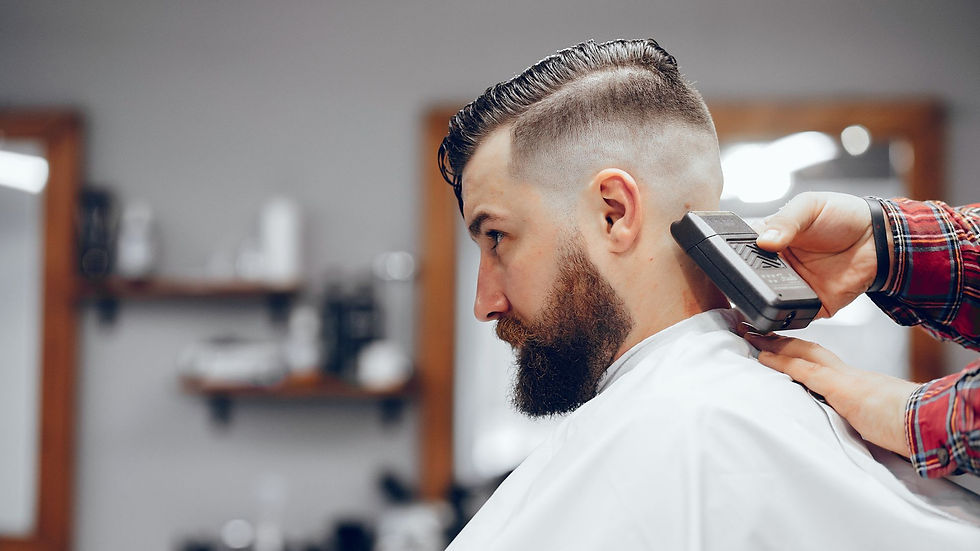
The Three Core Fade Heights
Fades are generally categorized by where the fade begins on the head.
Fade Height | Starting Point | Overall Look | Best For |
Low Fade | Just above the ear | Subtle, professional, understated contrast | Office environments, conservative styles, first-time fade clients |
Mid Fade | Between ear and temple | Balanced, noticeable but not extreme | Versatile everyday styles, most face shapes |
High Fade | Near the temple or higher | Bold, dramatic contrast, more attention-grabbing | Fashion-forward looks, thicker hair on top for contrast |
A Low Fade is often the safest entry point for guys who've never had a fade before, since the gradual blend starts higher up and keeps more length around the ear, creating a softer, more conservative transition. It's a popular choice for workplaces with conservative dress codes, since it reads as clean and sharp without screaming for attention. If you're unsure where to start, asking your barber for a Low Fade is a reliable, low-risk way to dip a toe into fade territory.
Skin Fade vs. Regular Fade
A skin fade (or bald fade) tapers all the way down to the skin at its shortest point, essentially blending into bare scalp before building back up to length. A regular fade, by contrast, never goes quite that short, leaving a thin layer of hair even at its shortest section. Skin fades tend to look sharper immediately after a cut but also grow out faster, meaning more frequent visits to maintain that crisp line. Regular fades have a bit more forgiveness between appointments.
Fade vs. Taper: The Comparison Clients Get Wrong Most Often
This is worth repeating because it causes more miscommunication than almost any other terminology mix-up in the industry.
Feature | Fade | Taper |
Shortest point | Can go down to skin | Rarely goes below a guard 1 or 2 |
Contrast | High, dramatic blend | Subtle, gradual blend |
Maintenance | Needs more frequent trims to maintain the line | More forgiving between appointments |
Best for | Bold, modern styles | Classic, professional, understated looks |
If you want something sharp but not attention-grabbing, ask for a taper, not a fade. If you want visible contrast and a more modern edge, a fade, possibly a Low Fade or mid fade depending on how bold you want to go, is the better request.
How Fades Interact With Hair Texture
Fades read differently depending on your hair's natural texture. On straight hair, the lines of a fade tend to look crisp and graphic, since the hair lies flat and the transition zones are highly visible. On curly or coily hair, fades can look even more striking because the contrast between the tight, shaved sides and the natural volume and curl pattern on top creates a built-in visual statement. If you have thinner hair, a very high, dramatic fade can sometimes look disproportionate, since there's less volume on top to balance the amount of skin showing on the sides, in which case a Low Fade or mid fade often creates better proportion.
Choosing a Fade Height for Your Face Shape
Round faces generally benefit from fades that start a bit higher, since the added visual height can elongate the face slightly. Square or angular faces often look great with a Low Fade, since the subtler transition doesn't compete with an already strong jawline. Oval faces have the most flexibility and can typically pull off any fade height successfully.
Talking to Your Barber About Fade Height
Rather than just saying "give me a fade," try something more specific: "I want something subtle for work, maybe a Low Fade that starts right above my ear." This gives your barber a clear target. If you're more open to experimenting, you might say, "I'm open to something bolder, what would you suggest for a mid or high fade given my hair texture?" Either way, naming the specific fade category removes guesswork from the equation.
Maintenance Expectations by Fade Type
Fade Type | Recommended Touch-Up Frequency |
Skin Fade | Every 2 to 3 weeks |
Low Fade | Every 3 to 4 weeks |
Mid Fade | Every 3 to 4 weeks |
High Fade | Every 2 to 3 weeks |
Lower, softer fades generally grow out more gracefully, while skin fades and high fades show growth more visibly and faster, since the contrast line becomes less defined as hair grows in.
Choosing the right fade height is only useful if you can communicate it clearly, and the single most effective tool for that communication is a well-chosen reference photo, which deserves its own closer look.
Bringing References: Photos, Pinterest, and the Celebrity Trap
"Can you give me what he's got?" is one of the most common phrases barbers hear while being shown a photo of a celebrity, athlete, or influencer. It's also one of the riskiest ways to communicate what you want, because a photo alone, without context, can lead to a result that technically matches the picture but looks completely different on you.
Why Photos Work (When Used Correctly)
Photos solve a real problem: words are imprecise, and everyone pictures "medium length" or "textured on top" slightly differently. A photo removes that ambiguity instantly. Your barber can see the exact proportions, the fade height, the amount of texture, and the overall silhouette you're aiming for. Used well, a reference photo is one of the most efficient tools in a consultation.
The Celebrity Trap
The problem arises when clients assume a photo guarantees an identical result regardless of their own hair texture, density, face shape, or hairline. A photo of a celebrity with thick, wavy hair and an oval face will not translate directly onto someone with fine, straight hair and a rounder face. The style might need to be adjusted, sometimes significantly, to actually flatter the person sitting in the chair.
This is where a good barber earns their reputation. Rather than attempting to force an exact replica, they'll explain the adjustments needed: "We can get a similar vibe, but given your hair's finer, we'll need to keep a bit more length on top for it to hold the same shape" or "Your face shape is a bit different, so I'd suggest tweaking the fade height slightly to balance things out."
How to Use Reference Photos Effectively
Do | Don't |
Bring one or two clear, well-lit photos | Bring ten photos of ten different styles with no clear priority |
Choose a reference with similar hair texture to yours | Choose a reference purely based on fame or trend, ignoring hair type |
Point out specific elements you like (the fade height, the length on top, the part) | Expect an exact, identical replica regardless of your features |
Be open to your barber's suggested adjustments | Insist on exact replication even when your barber flags a mismatch |
Use multiple angles if possible (front, side, back) | Rely on a single front-facing photo that hides the back and sides entirely |
Breaking Down What You Like About a Photo
Rather than just saying "this one," try narrating the specific elements that drew you to the photo. For example: "I like how short the sides are here, and I like the texture on top, but I don't think I want it quite this long in the front." This kind of breakdown helps your barber separate the parts of the reference that are achievable and desirable from the parts that might need adjusting for your specific head of hair.
Using Multiple References for Different Elements
Some clients bring one photo for the overall shape and a second photo focused specifically on the fade height or the beard pairing. This is a smart strategy because it isolates variables. Instead of asking your barber to interpret one complex photo, you're giving them two simpler, more specific references: "I want this fade height" and separately, "I want this length and texture on top." Breaking the request into components often produces more accurate results than asking for a single, holistic copy of someone else's entire look.
What to Say When You Don't Have a Photo
Not every client walks in prepared with a saved image. If you don't have a reference, describing the vibe you're after in simple, relatable terms still helps. Comparisons work well here: "Something like what I had two summers ago, but a little shorter" or "I want it to look more like how it looks when I style it on a good day, just cleaner." Barbers are used to working with imperfect descriptions, but the more concrete detail you can offer, even without a photo, the better the outcome.
When Your Barber Pushes Back on a Reference
If your barber tells you a particular reference photo won't translate well to your hair or face shape, take that feedback seriously rather than insisting on an exact match. This isn't your barber being difficult, it's professional judgment based on years of seeing how styles actually perform on different hair types. A good follow-up question is simply: "What would you suggest instead that captures a similar feel?" This keeps the conversation collaborative rather than adversarial.
Reference photos solve the "what" of a haircut, but there's still the "how often" question that shapes your long-term relationship with your barber and your overall grooming routine, which is where maintenance conversations come in.'
Talking Maintenance: How Often Should You Get a Haircut
One of the most overlooked parts of a barbershop consultation is the conversation about maintenance: how often you'll realistically come back, and how that timeline affects the style your barber recommends. A cut that looks phenomenal on day one but grows out awkwardly by week two isn't actually a great cut for your life, even if it photographed beautifully walking out the door.
General Guidelines for Haircut Frequency
Most grooming professionals suggest a general range depending on style and hair growth rate.
Style Type | Suggested Frequency |
Skin fades and high-contrast fades | Every 2 to 3 weeks |
Low fades and tapers | Every 3 to 4 weeks |
Longer styles with length on top | Every 4 to 6 weeks |
Buzz cuts | Every 1 to 2 weeks |
Beard maintenance (if paired with a cut) | Every 2 to 3 weeks |
These are starting points, not strict rules. Hair grows at different rates depending on genetics, health, and even season (many people notice faster growth in warmer months). Pay attention to how your specific style holds up and adjust your schedule accordingly rather than following a generic calendar.
Why This Conversation Matters at the Consultation Stage
Telling your barber upfront, "I can really only make it back every six weeks" changes what they'll recommend. A high-contrast skin fade that needs touch-ups every two weeks to stay sharp is a poor match for someone who can't commit to that schedule. Instead, your barber might suggest a softer taper or a style with more length overall, something that grows out more gracefully and still looks intentional even a month and a half later.
This single piece of honesty, admitting your actual schedule rather than an aspirational one, prevents a huge amount of post-haircut disappointment. Nobody wants to love their cut for exactly ten days and then spend the next three weeks increasingly frustrated as it grows out of shape.
At-Home Maintenance Between Visits
A good consultation also covers what you're expected to do between appointments. Ask your barber directly: "What should I be doing at home to keep this looking sharp until my next visit?" Answers might include specific product recommendations (a matte paste for texture, a pomade for shine and hold, a beard oil for conditioning), or simple habits like how to use a trimmer to clean up neckline growth between full appointments.
The Haircut Near Me Search Habit
For a lot of guys, especially those who travel for work or move between cities, finding a reliable barber isn't a one-time decision, it's an ongoing search. Typing "haircut near me" into a search engine is often the starting point, but the consultation is what determines whether that search leads to a one-time visit or a long-term relationship. A barber who asks good questions, listens to your maintenance realities, and delivers a style that fits your actual routine turns a random search result into your new regular spot.
Building a Long-Term Relationship With One Barber
There's real value in sticking with one barber over time rather than searching fresh every few months. A barber who's cut your hair multiple times already knows your cowlicks, your face shape preferences, your tolerance for boldness, and your typical schedule. Each visit after the first becomes faster and more accurate because so much of the initial consultation groundwork is already established. If you've found someone who consistently delivers, mention your maintenance needs once clearly, and future visits can often start with a quick "same as last time, maybe just a touch shorter" rather than a full conversation from scratch.
Adjusting Maintenance Expectations Seasonally
Some guys like to run a bit shorter in summer for comfort and a bit longer in winter for warmth and styling flexibility. If this applies to you, mention it during your consultation, especially if you're visiting around a seasonal transition. A simple heads-up like "I usually go a bit shorter for summer" helps your barber calibrate the cut appropriately rather than assuming your usual winter length preference still applies.
Maintenance conversations set realistic expectations for recurring visits, but not every trip to the barbershop is a routine maintenance appointment. Special circumstances, first haircuts for kids, gift certificate visits, or first-time appointments at a new shop, require their own approach to the consultation.
Special Situations: Kids, First-Timers, and Gift Certificates
Not every barbershop visit follows the standard script of a returning adult client explaining their usual routine. Fathers bringing in sons for a first haircut, gift recipients using a certificate at an unfamiliar shop, and first-time clients navigating a new barber relationship all require a slightly different consultation approach.

Bringing a Child in for Their First Haircut
A child's first haircut, or even their tenth, is a different dynamic than an adult consultation. Comfort and patience matter as much as technical direction. If you're a parent bringing your son in, a few things help the visit go smoothly.
Arrive a few minutes early rather than rushed, since a calm environment helps nervous kids settle in. Tell the barber directly if this is a first haircut or if your child has any sensory sensitivities, loud clippers can genuinely be frightening for a young child who's never experienced the sound and vibration up close. Many shops offer quieter clippers or will let a child hold the clippers off first to get comfortable with the sound before it touches their head.
Consideration | Adult Consultation | Child Consultation |
Primary focus | Style precision, face shape, lifestyle | Comfort, patience, positive experience |
Communication | Direct verbal description, photos | Simple, reassuring language, sometimes nonverbal cues |
Pace | Can move efficiently | May need breaks, slower pace |
Decision maker | The client themselves | Parent, with some input from the child when age-appropriate |
For style decisions, keep it simple. A classic crew cut or a basic taper is usually a safe, low-stress choice for a first few haircuts, since dramatic fades or intricate designs require a level of stillness that young kids haven't developed yet. As children get older and more comfortable in the chair, more detailed requests become realistic.
Gift Certificates and Unfamiliar Shops
If you've received a gift certificate to a barbershop you've never visited, the consultation becomes your main tool for bridging the gap of unfamiliarity. The barber doesn't know your history, your usual style, or your hair's quirks, so you're essentially starting fresh, similar to a first-time visit anywhere.
In this situation, over-communicate rather than under-communicate. Bring a photo if you have one. Describe your usual routine and maintenance habits even if it feels repetitive. Mention any past haircut experiences that didn't go well and why, this gives the new barber useful information about what to avoid. If you're unsure what to ask for at all, this is a great opportunity to simply say, "I'm open to suggestions, what would you recommend based on my hair and face shape?" A good barber will appreciate the openness and use it as a chance to showcase their expertise.
First-Time Visits in General
Even without a gift certificate, visiting any new barbershop for the first time benefits from a slightly more detailed consultation than you'd give your regular barber of five years. Since there's no shared history, take the time to mention things a longtime barber would already know: your cowlick, your typical maintenance schedule, styles that have worked well for you in the past, and styles that haven't.
A Comparison: Walk-In vs. Appointment for First Visits
Factor | Walk-In | Scheduled Appointment |
Wait time | Variable, sometimes long | Minimal, set start time |
Consultation time | Sometimes rushed if shop is busy | Usually more relaxed, dedicated time |
Barber choice | May be assigned to whoever's next available | Often able to choose a specific barber |
Best for | Simple, familiar styles | New clients, detailed consultations, special occasions |
For a first visit, especially if you're trying out a shop based on a gift certificate or a recommendation, booking an appointment rather than walking in tends to allow for a more thorough, unhurried consultation.
Buying a Gift Certificate for Someone Else
If you're the one purchasing a barbershop gift certificate for someone else, a thoughtful addition is a short note mentioning any style preferences you happen to know about the recipient, or simply encouraging them to have a full consultation rather than rushing through their visit. It's a small gesture, but it signals to the recipient that the visit is meant to be a genuine experience, not just a transaction.
Special situations like these highlight how much a consultation adapts based on context. But regardless of who's in the chair or why, there's one universal skill that applies across every single appointment: knowing when and how to speak up if something starts going in a direction you don't want.
Red Flags: When to Speak Up Mid-Cut
A consultation doesn't end the moment the clippers turn on. The best client-barber interactions include ongoing communication throughout the service, not just at the start. Knowing when to politely flag a concern mid-cut, and how to phrase it, can be the difference between a small adjustment and a result you're unhappy with for weeks.
Why Guys Often Stay Silent
There's a strange social pressure that kicks in once the cape goes on. Many clients notice something going slightly off-plan, the fade starting higher than discussed, more length coming off the top than expected, but say nothing out of politeness or a mistaken belief that it'll look better once finished. Sometimes that's true. Often, it's not, and small issues compound as the cut continues.
Barbers are professionals who deal with client feedback constantly. A polite, well-timed observation is not an insult to their skill, it's part of the collaborative process the consultation started. Most barbers genuinely prefer a client who speaks up early over one who stays silent and leaves unhappy, since the former gives them a chance to fix course while the latter just walks out dissatisfied.
Early Warning Signs Worth Mentioning
What You Notice | What to Say |
Fade starting higher than discussed | "I think that's a bit higher than we talked about, could we bring it down slightly?" |
More length coming off than expected | "That feels like more than I expected, can we pause and check the length?" |
Asymmetry forming | "I notice this side looks a little different from the other, could we even that out?" |
Discomfort or pain (clipper pressure, razor irritation) | "That's pulling a bit, could you adjust the pressure or angle?" |
Timing Matters
The earlier you speak up, the easier the fix. Flagging a concern two minutes into a fade is a quick adjustment. Flagging the same concern after the entire head has been cut to the new height is a much harder problem to reverse, since hair that's already been cut can't be put back. If something feels off, say so immediately rather than waiting to see how it looks at the end.
How to Phrase Concerns Without Being Confrontational
Nobody wants to sound demanding or rude in a service setting, but there's a straightforward way to raise concerns that keeps the tone collaborative. Frame it as a question or observation rather than a complaint: "Is this where we talked about the fade starting?" works better than "You're doing it wrong." The first invites a conversation. The second puts your barber on the defensive, which rarely improves the outcome.
Checking In at Natural Pause Points
Most barbers naturally pause at certain points during a cut, after establishing the fade line, before moving to the top, before the final line up, to assess progress. These pauses are great moments to glance in the mirror and confirm things are tracking toward what you discussed. A simple "that's looking good, keep going" reassures your barber and keeps momentum, while a concern raised at this stage is still easy to adjust.
After the Cut: The Final Check
Before the cape comes off, most shops offer a mirror check from multiple angles, front, both sides, and the back using a handheld mirror. Use this moment deliberately. Look closely rather than giving a quick glance and a reflexive "looks great." If something catches your eye, this is the last easy opportunity to request a small adjustment before you leave the chair.
What to Do If You're Unhappy After Leaving
Sometimes an issue isn't obvious until you get home, style it yourself the next morning, or see it in natural daylight rather than shop lighting. Most reputable barbershops have a policy allowing clients to come back within a short window (often a week or two) for a complimentary fix if something isn't right. Don't hesitate to call and explain calmly what's bothering you. This isn't an overreaction, it's a normal part of the service relationship, and most barbers would rather fix an issue for a client than lose them as a regular over something correctable.
Speaking up effectively during and after a cut closes the loop on a successful consultation process. But all of this groundwork only matters if you're sitting in the right chair to begin with, which means finding a shop and a barber suited to your specific needs in the first place.
Finding Your Shop: How to Search Smart When You Need a Haircut Near Me
Every great barber relationship starts with finding the right shop, and for most people today, that search starts online. Typing "haircut near me" into a search bar pulls up dozens of options, but not all of them are equally suited to what you're looking for. Knowing how to filter through those results, and what to look for once you walk through the door, sets the stage for the kind of consultation this entire guide has been building toward.
What to Look for in Online Reviews
Star ratings alone don't tell the full story. Read a handful of actual written reviews, paying attention to specifics rather than generic praise. Reviews that mention a barber's attentiveness during the consultation, their ability to execute fades cleanly, or their patience with first-time clients are more useful than a simple five-star rating with no detail. Look for recurring mentions of specific barbers by name within a shop, since that indicates consistency across multiple clients rather than a single lucky visit.
Portfolio and Social Media
Many modern barbershops showcase their work on social media, posting before-and-after photos of recent cuts. Scrolling through a shop's or individual barber's portfolio gives you a realistic sense of their specialty. Some barbers excel at intricate fades and designs, others specialize in longer, textured styles, and others are known for classic, traditional cuts. Matching your desired style to a barber's demonstrated strength increases your odds of a great first consultation.
Comparison: Independent Barbershop vs. Chain Salon
Factor | Independent Barbershop | Chain Salon |
Consultation depth | Often more thorough, relationship-focused | Can be rushed depending on scheduling |
Barber consistency | Usually request the same barber each visit | May see a different stylist each time |
Specialty services | Often includes straight razor shaves, beard trims | Typically more limited to basic cuts |
Price | Varies, often reflects specialization | Generally more standardized, often lower |
Atmosphere | Traditional, social, community-oriented | Quick, efficient, less personal |
Neither option is universally better, it depends on what you value. If you want a deep, ongoing relationship with a barber who remembers your cowlick and your usual order, an independent shop often delivers that more reliably. If convenience and speed matter more for a simple, low-maintenance cut, a chain salon can be a perfectly reasonable choice.
Calling Ahead vs. Walking In
If a shop's online presence doesn't answer your questions, call ahead. Ask about typical wait times, whether appointments are recommended, and whether a specific barber specializes in the style you're after. This small step before your visit sets up a smoother, more informed consultation once you're actually in the chair.
What a Good First Impression Looks Like
Once you're at a new shop, a few signs suggest you've found a place worth returning to. The barber asks specific questions rather than immediately reaching for clippers. They look at your hair texture and face shape and offer observations, not just instructions. They reference your mentioned lifestyle or maintenance habits while discussing the plan. These behaviors indicate a shop that treats the consultation as seriously as this guide has emphasized throughout.
Building Loyalty Once You've Found the Right Fit
Once you find a barber who consistently delivers, the smartest move is sticking with them rather than restarting the search every time you need a cut. Book recurring appointments if the shop allows it, learn your barber's schedule, and consider tipping appropriately for consistently great service, this reinforces a relationship that benefits you every single visit. The "haircut near me" search becomes a one-time exercise rather than a recurring source of uncertainty once you've invested in finding the right match.
Finding the right shop and barber closes the loop on everything this guide has covered, from understanding terminology to communicating face shape and lifestyle needs to speaking up during the service itself. The next step is putting it all together before your very next appointment.
Frequently Asked Questions
What should I say during a barbershop consultation if I don't know what style I want?
Be honest about your uncertainty rather than guessing randomly. Tell your barber your face shape concerns, your hair texture, and how much time you're willing to spend styling it each day. A good barber can suggest two or three options based on that information alone. You can also bring a general reference photo, even an imperfect one, since it gives your barber a starting point to work from and adjust based on their professional judgment.
How do I explain a fade to my barber if I'm not sure of the terminology?
Point to the general area on your head where you'd like the shortest hair to start, near the ear for a Low Fade, higher near the temple for a high fade, and describe how dramatic you want the contrast to be. Phrases like "something subtle for work" or "something bolder and more noticeable" help your barber translate your preference into the appropriate technical fade height, even without you knowing the precise terms.
Is it rude to ask my barber to redo part of a haircut if I'm unhappy?
No, it's a completely normal part of the service. Most reputable shops expect and welcome feedback, and many offer a complimentary touch-up policy within a short window after your original appointment. Calmly explain what's bothering you, whether it's an uneven line, a fade that's too high, or asymmetry you noticed later, and most barbers will happily make adjustments.
How often should I actually get a haircut to maintain my style?
It depends heavily on the style. High-contrast fades and skin fades typically need touch-ups every two to three weeks to stay sharp, while softer tapers and longer styles can often stretch to four to six weeks between visits. Be honest with your barber about your realistic schedule during the consultation so they can recommend a style that holds up well within your actual timeline.
What's the difference between telling my barber "shorter" versus giving a specific guard number?
"Shorter" is subjective and can mean vastly different lengths to different people, while a guard number (like a 2 or a 4) refers to a specific, measurable length. Using guard numbers removes ambiguity entirely and helps ensure the result matches your expectations rather than your barber's best guess at what "shorter" means to you specifically.
Should I bring my child to the same barber I use, or find a specialist for kids' haircuts?
Either can work well, but consider your child's temperament. Some barbers are naturally patient and skilled with nervous or wiggly kids, while others primarily serve adult clients and may feel less equipped for a child's first haircut. If your regular barber or shop offers kids' services and has good reviews specifically mentioning children, that's often a comfortable, familiar choice. Otherwise, seeking out a specialist or a shop known for family-friendly service can make the experience smoother.
How do I find a good barbershop if I've just moved to a new city?
Start with an online search and read detailed reviews rather than just star ratings, looking specifically for mentions of thorough consultations and consistent results. Check social media portfolios if available to match a barber's style specialty to what you're looking for. Booking an appointment rather than walking in for your first visit at a new shop often allows for a more thorough, unhurried consultation while you establish a new relationship.
What's the best way to describe my hair texture if I've never thought about it before?
Pay attention to how your hair looks when it air-dries without any product. If it lies flat with little volume, it's likely straight. If it has gentle bends or waves, it's wavy. If it forms defined curls, it's curly, and if it forms tight coils or zigzag patterns, it's coily. You can simply describe this to your barber: "it air-dries pretty straight and flat" or "it curls up pretty tight when it dries," and that alone gives them useful, actionable information.
Conclusion
A great haircut has never been purely about the barber's skill with clippers and scissors. It's a partnership built on clear communication, starting with a consultation that covers your face shape, your hair's natural texture, your real-life maintenance habits, and a specific, well-chosen reference point for the style you want. Add in the vocabulary to describe fade heights and guard numbers precisely, the confidence to speak up if something feels off mid-cut, and the patience to find a shop that treats your consultation seriously, and you've built a system that produces consistent results appointment after appointment, not just a lucky outcome once in a while.
The next time you sit down in the chair, skip the vague instructions. Tell your barber about your cowlick. Mention how many minutes you actually spend styling your hair each morning. Bring a photo, but explain what specifically drew you to it. Ask about guard numbers instead of settling for "shorter." These small shifts in how you communicate turn every single visit into a result you actually wanted, rather than a gamble you hope pays off.